

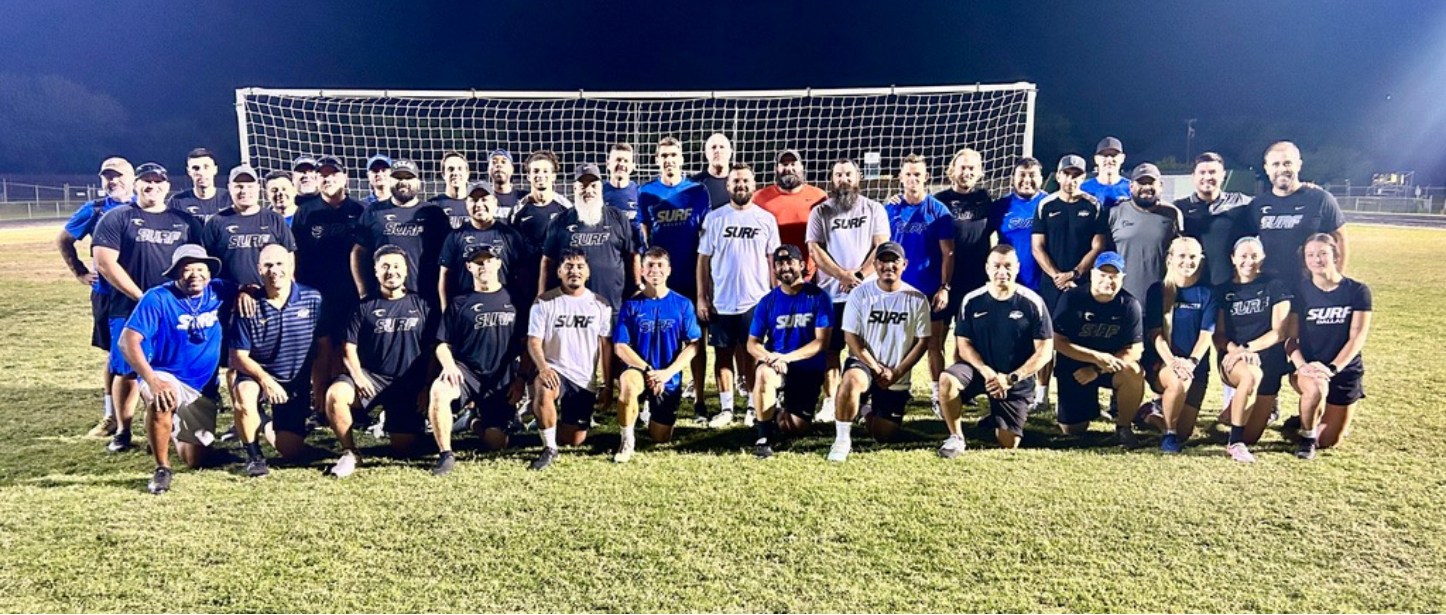
Why Designing Training Sessions?
Designing soccer training sessions is the backbone of coaching. When done well, they help players fall in love with the game, give clarity, build natural intensity and flow, and ensure learning transfers from training to matchday.
That’s why our second Coach Engagement Night focused on the fundamentals of designing soccer training sessions — one of the foundations of long-term player development. We came together to explore what it truly means to create sessions that bring joy to players, are game-relevant, and stay aligned with our player development philosophy and training methodology.
The goal was to get every coach on the same page about the universal reference points of soccer. In other words: what we coach — the objective knowledge we know to be true about the game — rather than how we coach through our own subjective opinions.
By clarifying what never changes, we build a stronger foundation for how we apply it as Dallas Surf coaches.
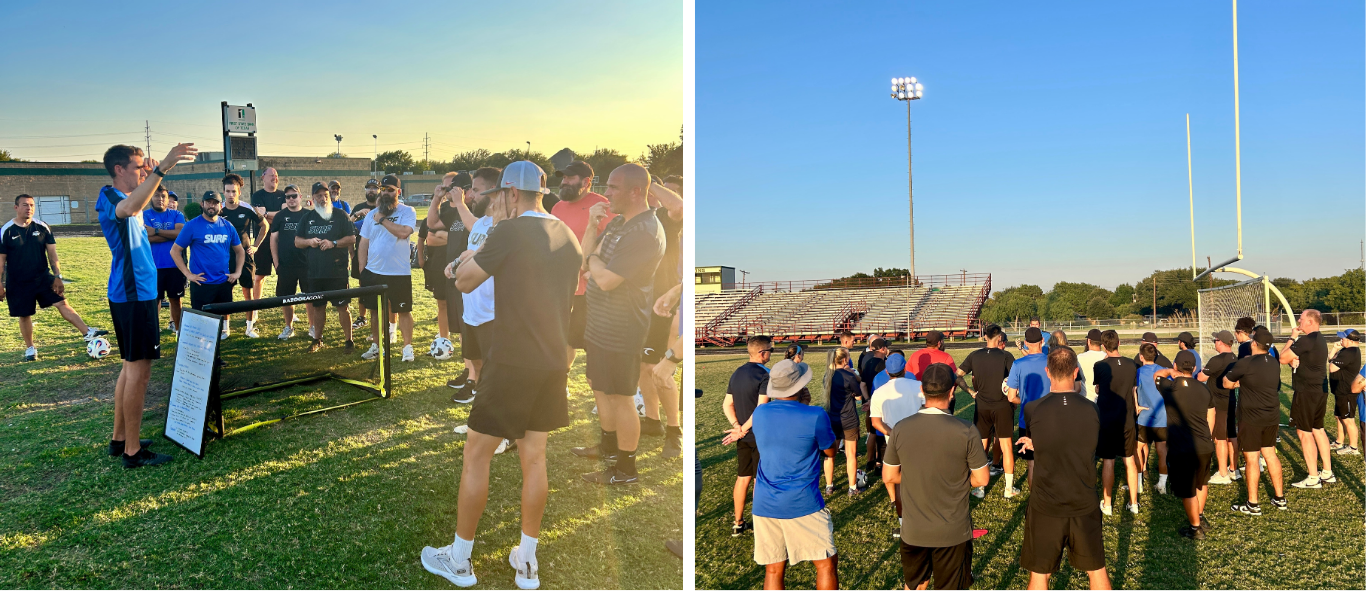
Our Director of Coaching & Methodology, Gavin Mole introducing the purpose of the evening.
Key Themes for Designing Soccer Training Sessions
- Joy Matters
Even as we focused on objective knowledge, we started with an important reminder: Joy fuels a love for the game, and that love fuels development. Joy is also contagious, keeping players more engaged, and drives long-term growth.
- Objective Truths are the Starting Point
Whether it’s professional or amateur, men’s or women’s, 11v11 or 3v3 — the game is always the same: One team tries to score and the other tries to stop them and both transition between those states many times during a game. Using Raymond Verheijen’s approach, Soccer can be broken down into soccer actions such as passing, pressing, dribbling, and finishing. Each action has three inseparable components:
-
Communication (C): Where are my teammates? Where are the opponents? What space is available?
-
Decision (D): What should I do, and how should I do it?
-
Execution (E): Executing the decision (technique).
The important point is that execution never comes first. Soccer is a contextual game, which means the rule for training must reflect that. If we design practices that remove communication and decision-making, we move away from the truths of the game. There is a place for isolated practice, but if we accept soccer is a contextual game, then context is the rule. If you move away from that, then we must argue for (isolated) it and not the other way around.
- Core Games That Cover All Aspects of the Game
We don’t need endless ‘drills’. What we need are repeatable core ‘games’ that players love, where we can scale the challenge up or down to suit the players in front of us. These games should be Simple (more below) & cover all parts of soccer, CDE & game situations (building vs pressing, scoring goals vs defending the goal).
The game itself is the teacher — but this isn’t simply “let them play.” Our job as coaches is to design the environment (exercise) so that learning happens through the exercise, then step in with interventions that connect the activity to the game and accelerate transfer.
- Simplify – Clarity Over Complexity.
Every session should have one clear focus. This gives clarity to players: “This is the focus. This is the problem we are solving. This is why we are working on it.” In other words, we use our core games to help them to solve a soccer problem. Why core games? Consistency helps us perfect, we eliminate games that aren’t helping us improve or the players dont love, we can gradually increase overload because we have a clear reference for player development.
The games should be simple? (Simple does not mean its easy!) Players can think about the problem they are trying to solve and not the complicated rules of the exercise. The game already contains everything you need, remove anything that create distraction from the focus.
“Simple isn’t easy, simple is clarity.”
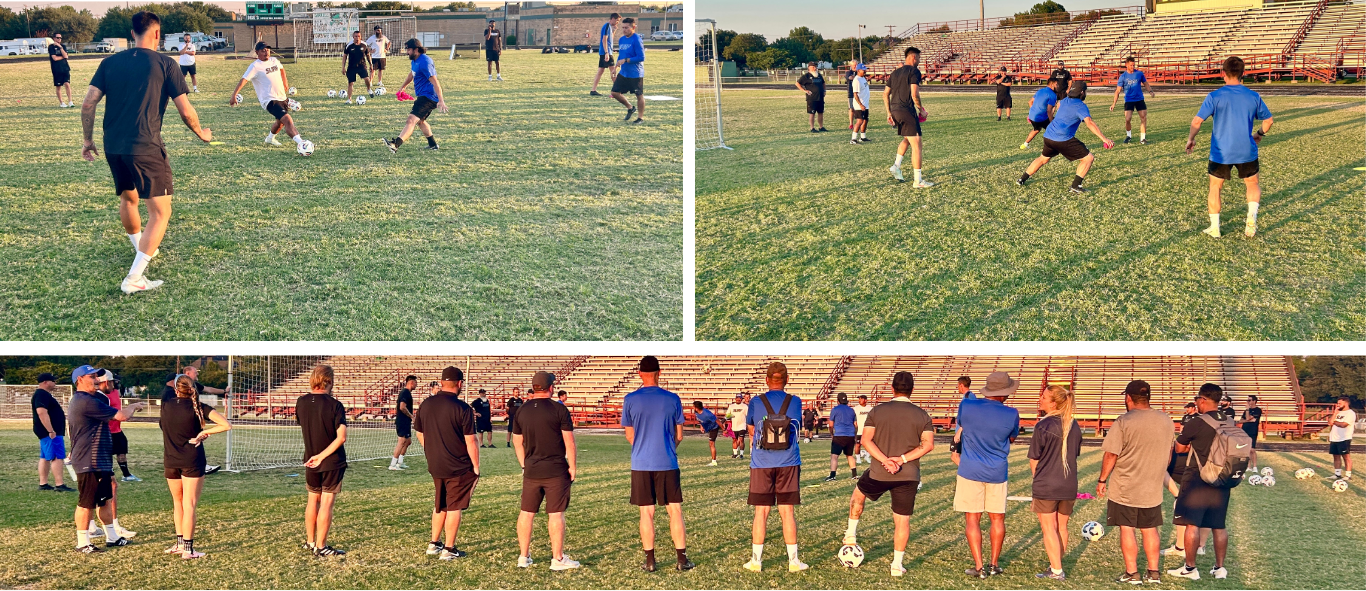
Our coaches working hard during the session. Learning is more fun, when you are playing, kids or adults!
On-Field Session Highlights
To put these ideas into action, our staff stepped onto the field together and ran through a 90-minute session. This is what the session looked like…
-
Rondo Variations:
-
2v1 Dribbling/Finishing:
-
4v4 + 3 Positional Game:
-
5v5 Small-Sided Game:
-
9v9 Team Game
Every activity included CDE (communication → decision → execution), always in context and under pressure from opposition. We also included all game situations, build vs press, score vs stop goals and transitions were present throughout.
It’s important to remember that the specific exercises themselves aren’t what matter most. There are countless drills we could choose from. What matters is the intention behind the design — what problem we’re solving, and how the activity helps players find solutions.
This session focus: Can we progress beyond at least one line?
This meant every player (coach) had to solve soccer problems, interact with the soccer environment (team/opponent), had many opportunities to make decisions (what and how) and execute that decision using technique.
Key Takeaways
This night wasn’t about just showing coaches exercises and a session — there is no purpose or why behind that? As we have said, clarity is key, for players or coaches. It was about aligning on the universal truths of the games and using those to raise training standards, and therefore player development.
Main takeaways:
-
Joy fuels motivation — and motivation drives intensity, which drives development.
-
Soccer truths never change — every action is communication → decision → execution.
-
The game (context) is the starting point — if you move away from that, what’s the purpose?
-
Core games are enough — adapt them to create the right challenge for your players.
-
Clarity beats complexity — simple isn’t easy, but clarity is what players and coaches need most.
We’re proud of our staff for stepping on the field, engaging fully, and challenging each other as we continue to build a ‘best of the best’ environment for our players and staff.

Want more youth soccer insights?
Our Insider shares practical tools to help kids thrive in youth soccer — with tips for parents, coaches, and players. From training ideas to parent support and player nutrition, all designed to support your player’s journey on and off the field
